“Have you ever thought about living off the grid?”
The question took me by surprise, in part because we had been talking about federal grants at the time and usually when Anthony changes topics he signals it by saying, “Random question … .”
It also caught me off guard because I happened to be reading a book about a guy who lived off the grid — way off the grid — in Western North Carolina. He’d begun his love affair with the woods as a teen, to get away from his father. When he reached the age of consent, he went at it full-time, with his mission to bring all of America with him. There was a lot to admire in this guy’s quest, which was largely driven by a love of the natural world and a desire to preserve it. A desire that included living in a low-impact teepee; drinking spring water; learning about ,and living off the plants around him; eating road kill. I was thinking about the latter when turned to Anthony and asked, “How far off the grid are you talking about?”
“Not having any bills to pay,” he answered. That, some follow-up questions revealed, meant still having modern conveniences — appliances, for instance — just not buying them on time. And also having a self-contained power system — solar, a water wheel, etc.
We then asked each other how long we thought we could live off the grid.
“Not very long,” Anthony speculated.
“A weekend,” I answered. “Or up to a week.”
My answer was based on fact because I’d done it maybe 100 times over the past two decades. Or roughly how many times I’ve gone backpacking.
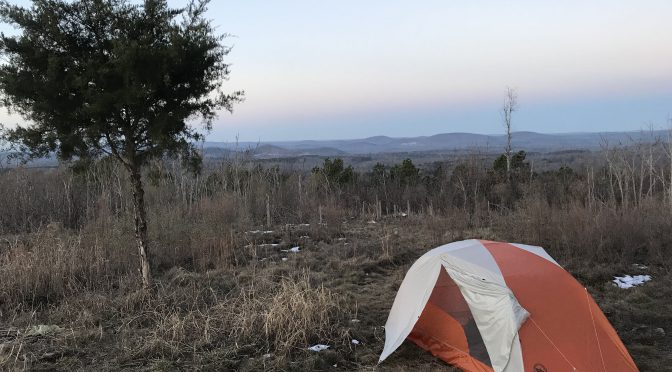
As Anthony and the fellow from the book demonstrate, living off the grid means different things to different people. I draw the line at eating roadkill and foraging for certain wild foodstuffs. Mushrooms, for instance, where there can be a very fine line between a fungi that sautés nicely over a camp fire and one that will kill you. I’ve drunk from many a spring (filtering if I think the source suspect), and while I’ve yet to build a shelter, it’s on my list. Until then, I’m content to sleep in a tent.
Off the grid? Well, I need no outside power sources to get by, I’m self-sufficient, and because I’m observing Leave No Trace, I’m living harmoniously with nature. I may not be eating squirrel with a tire-track down its back and it may only be for a weekend, but it is, for the time being, the right amount of OTG living for me.
One last thing. That book I’m reading came out in 2002. Toward the end of the book the subject was growing suspicious and distrustful of others. I was curious about what had become of him, so I Googled him to see if he’d stuck with it and if so, how a lifetime spent off the grid had worked out. Not so good, it turns out. He’s less well-known today for his environmental efforts, more for his embrace and promotion of conspiracy theories. Apparently it takes a special kind of person to live entirely off the grid.
Because I’m not special, I will confine my off-grid living to weekends, beginning Fridays after work, continuing through late Sunday. I’ll be in a tent, I will have hot coffee in the morning (thanks, JetBoil), I will have a comfortable place to sit and savor the evening (yo, Helinox Chair Zero). Off the grid, away from the grind.
At least for a weekend.