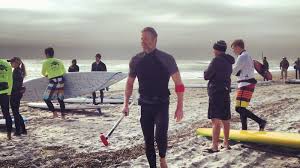
It wasn’t hard to figure out why the 250 or so Broughton High School International Baccalaureate students were so taken with elite climber Mark Synnott’s message earlier this afternoon.
One, he was talking about the remote and curious nooks of the world his “job” as a professional climber has taken him. And there was his stint as founder and president of the Crazy Kids Club of America.
Synnott was giving the Broughton students a preview of the talk he’ll give this evening at 6:30 p.m. at the N.C. Museum of Natural Sciences in downtown Raleigh.
Synnott has been part of The North Face’s elite climbing team for 17 of his 43 years. At first, he was primarily motivated by the climbing. But he quickly discovered something interesting about every place he went, no matter how remote it was.
“There were people there,” says Synnott, whose home base is in Jackson, N.H. “Everywhere I went, there were people.”
He quickly became just as intrigued by the people as the climbing.
In the Musandam Peninsula at the Straight of Hormuz, for instance. Accessible only by boat — and then a challenge considering the peninsula is notable for its 2,000-foot rock faces that jut out of the straight — the inhabitants speak a unique language based on Persian and Hindi but that borrows from Spanish, French, English and other languages. No one, not even the residents themselves, know how they got there.
“In one village, everyone had the same last name,” Synnott said.
Then there were the two gentlemen they encountered on camels in the Sahara desert of northern Chad. The pair were returning from a salt run to Libya. When the pair saw the strangers in the four-wheel drive vehicles, one quickly dismounted and began milking his camel.
“It’s a custom in many of these areas to give your guest something,” Synnott explained. As the man presented the climbers with a tin of fresh camel milk, Synnott quickly thumbed through his Lonely Planet Guide to see what it had to say about drinking unpasteurized camel milk.
The recommendation? “Not advisable.”
“It was a bad scene,” Synnott said of the aftermath. “Nobody died, but we wished we had.”
Then there was the Crazy Kids Club of America. The club, of which boyhood friend and Tour de France cyclist Tyler Hamilton was also a member, involved crazy stunts that Synnott would dream up. Complete the stunt and and you’d get a cardboard Burger King crown bearing the image of a kid jumping off a cliff.
“We were really into pole vaulting,” Synnott said by way of example. “Only not for height, for distance. We’d pole vault over these icy rivers in the winter. The bigger kids, we’d just barely make it,” he said, a smile beginning to creep across his face. “The little kids wouldn’t make it.”
Synnott will share more stories from the remote corners of the globe tonight at the N.C. Museum of Natural Sciences, 111 W. Jones St., Raleigh . General admission is free, reserved seats at $10, all tickets must be reserved online by going here.
90 Second Escape: Running Water
Monday — never an easy time for the outdoors enthusiast. After a weekend of adventure, returning to the humdrum work-a-day world can make one melancholy. To help ease the transition, every Monday we feature a 90 Second Escape — essentially, a 90-second video or slide show of a place you’d probably rather be: a trail, a park, a greenway, a lake … anywhere as long as it’s not under a fluorescent bulb.
Fall color: Going, going …
Last weekend’s fall color was pretty spectacular in the Piedmont. And practically over in a flash.
I was fortunate enough to spend the day hiking in Greensboro: along the Watershed Lakes, at Guilford Courthouse National Military Park, at Hagen Stone Park. Twenty miles of spectacular color under mostly sunny, cool skies. Yet driving home to Cary, I could already see the color retreating from the roadside woods.
This weekend: Play with the sun
The statewide forecast for the weekend: Sunny with highs in the low 60s, which makes this an ideal weekend for just about every outdoor adventure. We offer three options especially well-suited to the forecast.
Coast
Right now is about the time it’s comfortable — and sane — to start venturing into a coastal forest. (Between April and November, exploring coastal forests is tantamount to offering room service to any bug that sucks blood for a livelihood.) That makes it the ideal time for “The Forest of Goose Creek: Past, Present and Future” at Goose Creek State Park near Washington (North Carolina’s Washington, the pleasant one). A ranger leads you on a hike of the Ivy Gut Trail and fills you in on the natural and cultural history of this park, located along the mighty Pamlico River just before it becomes the mighty Pamlico Sound.
Why don’t you hike with poles?
My favorite correspondent reported in from Colorado that she’d been hiking an area known as the hogback, a geologic formation that constitutes a precursor to the foothills of the Front Range. Having once lived near the hogback, she knew that in itself would interest me. Then she sweetened the pot.
“A lot of the hikers were using hiking poles,” she said. And no, she confirmed, they weren’t all older hikers. “It was a mix.”
It struck us both ironic that in the fitest state in the nation hikers are quick to use the aid, while here in one of the least fit states we continue to wobble along poleless. One thing those Coloradans may know that we don’t: using poles makes for a better workout.
“Walking poles work your arms, shoulders, chest and upper back muscles through a functional range of motion as you walk — which can help you turn your daily walk into a full-body workout,” according to Dr. Edward R. Laskowski with the Mayo Clinic. “The arm movement associated with walking poles adds intensity to your aerobic workout, which helps you burn more calories.”
I lead a couple of hiking groups, including GetHiking! Triangle. Courtesy of Great Outdoor Provision Co., I keep six loaner hiking poles in my car trunk. Before every hike I announce their availability. On a recent outing with 43 hikers, four took me up on the offer, with two making comments to the effect of, “Guess this makes me old now.”
No, using doesn’t make you old. In fact, it keeps you from getting old, at least parts of you. Other advantages to poles, according to Dr. Laskowski: