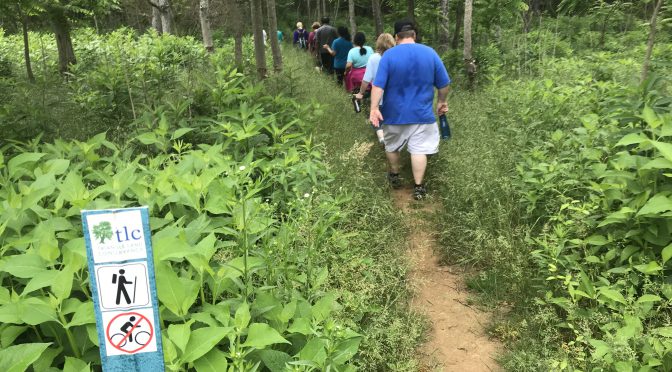
I used to love hiking in summer heat. The past couple years, though, not so much. Coming into this summer I got me to wondering why.
As we’ve settled in to summer’s steady drumbeat of 90/90 — temperature/humidity — days, I’ve been trying to sort out what I don’t like about summer hiking, as well as what keeps me on the trail. The latter first.
The case for summer
 No crowds. Summer hiking is an acquired taste, a taste even the most ardent hikers haven’t acquired. Thus, if you’re not into sharing the trail, it’s the time to be on it.
- The intimacy. Especially in a summer as wet as this one, every nook of the forest is adorned in green: a rich canopy, a robust understory, a thickly carpeted forest floor. All help insulate you from the world beyond, and when it comes down to it, isn’t being shielded from the outside world a big part of being outdoors?
- Hot bod, I. As you age and your body stiffens, nothing works out the kinks like the heat. On a 90-degree day those stiff joints all-but-disappear within minutes of hitting the trail. Think of it as the benefit of a steam bath while enjoying a walk in the woods.
- Hot bod, II. Hiking is a good way to firm up and lose weight. Hiking in hot weather accelerates the process.
- It makes you a kid again. For most of us summer was our favorite time of year. No school, all play, all day. Recapture that feeling with a summer hike. And maybe to capture that feeling of summer youth throw a little water into the mix. One of the best days I’ve had on the trail was last year nearing the end of a 14-mile loop at Doughton Park and pausing to remove my hiking shoes and dip my feet in the cold water of Basin Creek. Had there been a pool deep enough I would have been all in.
Pretty good case for a summer hike, I believe. Now, on to the downside and how I deal with it.
The downside (and dealing with it)
- Sweaty eyes. There’s an easy solution to keeping salty sweat from dripping into your eyes, obscuring your vision, and making you crabby: a bandana, or Buff. You could use a ball cap, relying on on the headband to absorb your salty discharge, but the closed top causes heat build up. Solution? A wrap-around cloth that lets heat evaporate but catches sweat. And when it reaches maximum capacity, simply remove, wring, replace.
- Dehydration. You need to replace all that sweat leaving your body, lest you succumb to a summer swoon. Take a minimum of two liters of water, regardless of how long and far you plan to hike. Of course, simply having water doesn’t mean you’ll drink it. Which leads to …
- Make it a cold one. One of my favorite songs as a kid growing up out West: “Cool water,” the Marty Robbins version. Clear, cool water to be precise. Which is why every night before a summer hike I stick a couple of three-quarter-full water bottles in the freezer. Next morning I top them off with cold water and I generally have clear, cool water for most of the hike — water I look forward to indulging.
- Pack extra socks. Always pack an extra pair of socks and swap ‘em out before you hear the tell-tale squish-squish-squish of your feet swimming in your socks. When that happens, take the socks you’ve just removed and tie ‘em to the back of your pack. Within a half hour or so a pair of wool socks will dry just enough for you to put back on, should the need arise. (Help yourself even more by wearing lightweight summer hiking socks.)
- Vanquish the pests. I use DEET, deemed safe in concentrations of less than 30 percent, to rid myself of most summer pests. Most, but not all. …
Quick story: Years ago I was complaining to a former superintendent at Umstead State Park in Raleigh about her horse flies. “I’m on my mountain bike,” I explain, “trying to outride this especially pesky horsefly. I’m peddling like mad, but it keeps nipping at my ears. I look down at my speedometer and I’m going 35 miles per hour!”
“The park speed limit is 20,” she replied.
In fact, it wasn’t until recently that learned of the one thing that does seem to keep horse flies at bay.
Vinegar.
Like, a dab behind the ears?
Exactly. Although if the thought of smelling like a tossed salad on the trail doesn’t appeal to you, any essential oil — citronella, eucalyptus, lavender, peppermint — will do. A spritz or two about the head and summer hiking’s real nemesis will be someone else’s problem.
So, in addition to your Ten Essentials, add an 11th.
A lavender sachet.