I got into exploring off trail more than a decade ago because after a while, hiking the same blazed trails over and over became surprisingly routine. When I began veering off trail, every outing became more of a true adventure. With no script, these freelance adventures revealed new discoveries every time.
Recently, though, I discovered that a certain amount of routine can settle into a seemingly unscripted off-trail adventure. The path you took the first time on terra incognito quickly ingrains itself into your subconscious and, dang!, you find yourself taking the same route over and over.
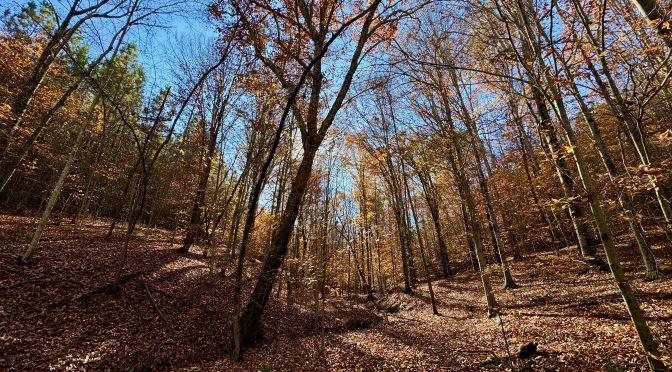
For the last three years or so I’ve done most of my off-trail exploring in the Dan River Game Lands along its namesake river in the North Carolina’s northern Piedmont. At 1,700 acres, it may seem small by adventure standards: Umstead State Park in Raleigh, by comparison, has about 5,600 acres. But when you consider that the Dan has no marked trails, only a handful of restricted-access gravel roads and dozens more old farm roads gradually fading into history, it’s easy to make a day’s adventure out of just a fraction of those forested acres. Provided you go with the wild rather than try to tame it.
Which is what I found I’d been doing of late.
I’ve got an hour, I’ll tell myself. I’ll do the Woodpecker Ridge loop. Or, I’d like to see the river. Reckon I’ll head down from the Riverside Loop entrance — that’s the fastest route. Or, I need to get in 3 miles, I know just the route … .
Every visit, I discovered, was programmed. So I came up with different strategies to inject a sense of adventure back into my off-trail adventures, such as:
- Explore by points of the compass. Years ago I used to take lunchtime walks by following a point on the compass: Head due north for 30 minutes, return heading due south. In this off-trail iteration I follow the compass as closely as possible (veering to avoid bodies of water, cliffs, etc.) for a set amount of time, then retrace my tracks — my literal tracks — not using my compass. This approach works two skills: navigation and tracking.
- Hike for a set amount of time. The goal here is to keep track of your route well enough to make sure you return to your starting point in a set amount of time. To avoid doing a simple out-and-back, you need to make a minimum of two right-angle turns, essentially hiking in a triangle. The trick is to keep track of the time and the amount of ground you’ve covered to make it back in time.
- Hike to a known landmark and back. Using a good topographic map, pick an obvious landmark — a peak, a pond, a stream — set your bearing from your start point, and head out. Because you’re rarely able to walk a straight line — that is, a straight bearing line — in the woods, you’ll need to pick intermittent landmarks along that straight line whenever you’re forced to veer from your bearing.
- Hike for a half day, with no set agenda. This is my favorite, when I have the time. This approach accommodates true wandering — to a degree. I like to spend the first hour or so simply following my whim. Then, I’ll stop, consult my map, figure out where I am. Because I do need to get back at a specific time, I’ll see if I have time to go further, or whether I need to head back, though not necessarily by the same route. Maybe I’ll start heading in the general direction of where I started, but explore adjoining terrain, again, keeping track of the time and where I am on the map. I’ll likely stop and reassess after a half hour or so. A nice mix of mindless wandering with occasional reality checks.
- Hike for 20 minutes, then stay put for 10. One thing you’ll notice about off-trail hiking is that you won’t notice as much wildlife. It’s a mystery until you realize you’re tromping over broken branches, through piles of loose leaves, and under dead tree trunks: you’re making so much noise that they’re skittering away from you — and you wouldn’t be able to hear them anyway. But the wildlife is out there, so: Hike for 20 minutes, find a somewhat open spot, get comfortable, then stand and listen and watch for at least 10 minutes. It starts out quiet, but once you settle in you’ll be surprised by the overall sensory experience.
Obviously, these tactics require some comfort working with a map and compass. If you’ve yet to acquire those skills, you’re off-trail exploits are best kept to following old roadbeds that are easy to distinguish and will be easy to retrace. Just make a note of any deviations you make from the main path.
And if you’re interested in exploring off trail, stay with us. We’ll be writing more about why to explore off trail and how to do it in the year ahead.