It was coming up on 4 p.m. on New Year’s Day when I got the nagging feeling I’d forgotten something. Black-eyed peas, check. Resolutions for 2026, check. Sticky notes all around to remind me to write “2026,” check. What could it —
Oh yeah — a hike!
Technically, I’d taken one earlier in the day, but it was more a traditional get-your-miles-in-and-heart-rate-up hike. What I hadn’t done was a true adventure hike, the kind I had vowed to do more of in 2026: An off-trail hike.
In year’s past, all my hiking resolutions had been blazed-trail centric. Hike a new (blazed) trail every month. Do at least one 10-mile (blazed) trail hike every quarter. Do a new stretch of the (very obviously blazed) Appalachian Trail. 2026 would be the year I eschew the blaze.
I checked to see how much time I had: sunset was at 5:14 p.m.; it was a 10-minute drive to my local off-trail stomping grounds, the Dan River Game Lands, and if I left now I’d have just about an hour of sunlight to work with. On a regular trail, a blazed trail, that would translate to about 3 miles of hiking, and if I overshot sunset by 10 or 15 minutes, no big deal. Not so when you’re exploring off-trail. In fact, depending upon your location you could be hiking in the dark well before sunset. That gave me pause, reminding me that especially when heading off trail it’s wise to think before you leap. A few thoughts on thinking, based on my New Year’s Day hike:
Thought 1: Late in the day? Choose a west-facing location. This thought in mind, I entered from the Riverside Drive access, which sits on a plateau sloping west down to the Dan River..
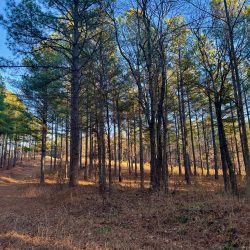
Thought 1a: Late in the day? Choose a mature hardwood forest. Why? Because such a forest is likely to have minimal canopy in winter and thus, let more light in. That proved a bit of a challenge on this 1,700-acre game land, which was farmed as recently as 20 year ago and consists largely of young, pines and hardwoods elbowing branch-to-branch for precious sunlight.
I set off down a dirt road closed to the public and used only occasionally by the Wildlife Resources Commission for maintenance. I hiked a third of a mile down a gentle slope, then the road dropped nearly 100 vertical feet in a third of a mile. The road fizzled into brush; it was time to head truly off trail.
Thought 2: Be cognizant of the time. It was about 4:25 p.m.; sunlight wasn’t an immediate factor, but it time was important to factor it into my decision. To the north, the forest floor was relatively clear of growth. The slope was also catching the waning sunlight and it was in the direction I needed to head; I struck off not straight uphill, but making sure I didn’t lose elevation; in the next 15 minutes or so I needed to regain the ridge.
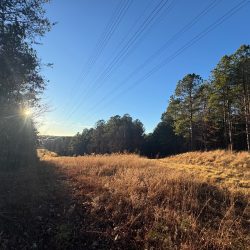
Thought 3: Have a plan. Probably should have started with this, but it was now that I needed to take the goal of my hike into account. Granted, my overall goal was to make it back to the car before dark. But what I really wanted was to catch the end-of-day light while hiking through an upland meadow nearby. I would be heading west, directly into the fading sunlight; with clear skies the sunset should be spectacular. My plan to regain the ridge would get me within 5 minutes of the meadow.
Thought 4: Brambles and briars slow a body down, especially in the dark. My chosen path had looked clear, but in fact was laced with barely visible waist-high brambles and briars. Much easier to see and deal with in the light.
Thought 5: Rootball holes and other obstacles. The winter woods are covered with fall’s leaf and pine straw harvest, which does a fine job of masking obstacles such as rootball holes, downed branches and rocks. Again, much easier to deal with in daylight.
Thought 6: Have intermediary goals. My goal was the meadow and it was almost due west. Because I couldn’t see it, though, and because I didn’t want to be constantly consulting my compass, I picked intermediary landmarks to the west that I could see. I’d reach the landmark, then find another on a westerly course. Slow, but steady and reliable.
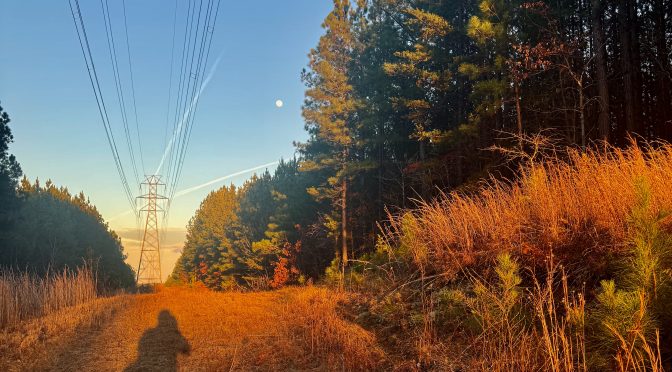
Thought 7: The path of least resistance. I reached the ridge, which housed a power line cut-through, at about 5 p.m. A strip of woods maybe 50 yards wide separated my from the meadow. Having hiked here before I knew that if I hiked southwest another 5 minutes I would find an opening, a much better option in the fading light than bashing through dense woods.
Thought 8: Don’t get cocky. I entered the meadow at 5:07 p.m., 7 minutes before sunset. The setting sun was indeed what I’d hoped; my inclination was to stop and savor. And while the last two-tenths of a mile back to the car was relatively easy, it was still off-trail through a meadow. I needed every ounce of sunlight I could get.
Thought 9: Don’t cut it too close. I got back to the car at 5:13 p.m. There was maybe another 5 minutes of useable light in the meadow; the useable light in even the most open forest had been exhausted a good 20 minutes earlier. Not bad timing, I thought.
Thought 10: Stay a moment and savor the waning light. Probably doesn’t need saying, but why not!
A great start for 2026, and hopefully an omen for a year of memorable off-trail adventure ahead.