
I’d just finished leading a hike at the Butner Game Lands along Falls Lake. I had 5 miles under my belt, a good day in my book, and besides, I had a boatload of chores to do at home. But the sky was a cloudless blue, the temperature was on its way into the mid-70s, and I was 15 minutes from the only place in the piedmont where I was 99 percent sure I would find the thing that, for me, means spring has truly arrived.
Trout lilies.
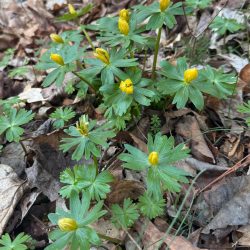
You may hear your first spring peepers as early as late January, and a daffodil or two may pop through the first week of February. The former is assuring, yet you still know that cold weather lies ahead (and this year, 14 inches of snow). They don’t even wait for Imbolc, for pete’s sake. The latter, the daffodils, carries with it an asterisk: it’s not a native plant; rather an ornamental that doesn’t abide by local rules of seasonality. Ah, but the trout lily: spring’s true first responder. Once the trout lily raises its lovely maroon-striped yellow petals to the sky, there’s no turning back.
For six years, I was fortunate to live in Hillsborough, where, early on I discovered the Poet’s Walk at Ayr Mont, a preserve that grew out of a former plantation. Today, while the focal point is the Federal style plantation house, the hidden gem is the mile-long Poet’s Walk, a natural surface path through maintained meadow and bottomland forest.
This time of year, the half mile that borders the Eno River through floodplain hardwoods offers one of the best sites around to catch the first trout lilies of spring. Alas, since moving from Hillsborough four years ago, I’ve yet to find as reliable a source for my trout lilies as the Poet’s Walk. One year since I was lucky enough to stumble across some along the banks of the Cape Fear River near Dunn. Another, it wasn’t until May, in the Pisgah National Forest. Two years, I went without completely. That wasn’t going to happen this year.
I pulled into the half-full gravel lot around 11:30 on a Sunday morning and set out down the trail, which begins through a manicured meadow. A third of a mile in the trail entered forest and I was surprised by the sight of winter aconite at the base of an oak just off trail. An ornamental, but none the less, a “harbinger of spring,” as my PictureThis app informed me.
In another hundred yards, I slowed; here, the trail flattened and it was here that the spring wildflower show traditionally began. Sure enough, a half mile in I spotted my first yellow fronds. Five in all, all still bundled together. Sunlight had only recently penetrated this part of the forest floor; there was no reason to completely unfurl and gather spartan energy.
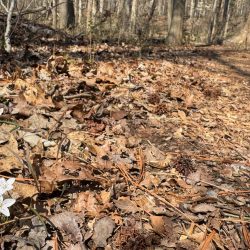
I walked slowly and saw more trout lilies cautiously casting about. I also glimpsed a handful of spring beauties, usually the second wildflower to emerge along the Poet’s Walk. In a week or two, their delicate round petals would dominate the landscape.
I spent 45 minutes slowly walking back and forth along this stretch, hopeful that the prolonged sunlight would elicit a burst of yellow petals. They may have opened a bit, but it would be mid- to late-afternoon until they truly unfurled. And I had a house-load of spring chores to do.
No matter. Spring, for me, was officially underway.
* * *
Find spring
Looking to find signs of spring? A few thoughts.
“Wildflower Walks to Take in the Triangle,” Walter Magazine. Five popular destinations recommended by a guy we know. Find it here.
Eno River Association Spring Wildflower Hike Series. For as long as I can recall, the Eno River Association has been conducting guided walks along the Eno. The scheduled is based on years of observation: if the ERA thinks there’s going to be wildflower action at Penny’s Bend Nature Preserve on March 15, you can bet there’s going to be a show. Learn more here.