My buddy Alan and I celebrate our birthdays (they're a day apart) by doing a mountain bike ride that's the average of our combined ages. This year, we rode 58 miles.
As I was poring over the results of Sunday’s Off Road Assault on Mount Mitchell, I was surprised to see that of the nearly 400 riders who finished the 63-mile race, only five were older than me. (I was less surprised that all five finished ahead of me.)
Perhaps I shouldn’t have been; at 56 years of age, you might think that wisdom would finally overpower the need to punish one’s self, thus keeping contemporaries away.
Apparently not.
I became curious about my fellow silver cyclists and discovered that, indeed, we are not becoming sedate and reflective in our golden years. According to the National Sporting Goods Association, the number of mountain bikers age 55 or older grew by more than 41 percent in the past decade. In 2011, there were 383,000 mountain bikers who were eligible for 10 percent off their curly fries at Arby’s, up from 271,000 10 years earlier. (Curiously, the overall number of mountain bikers dropped 5.5 percent during the same 10-year span.)
Mountain biking was no anomaly. The number of 55ers working out at gyms climbed 614 percent during the period, the number of 55+ kayakers rose by 350 percent, the number who did aerobic exercise increased by 226 percent. Growing interest in these more active pursuits outpaced growth in activities typically associated with a graying population: golf, darts, fishing and bowling, to name a few.
This week, Ultimate Hike Raleigh began its recruiting sessions in the Triangle and, again, I shouldn’t have been surprised by the number of people in the audience who also looked like they remembered “Fernwood Tonight.” At the end of Tuesday evening’s info session Tuesday at the North Hills REI I struck up a conversation with a 50-year-old woman who had signed on for the 28.5-mile hike to benefit pediatric cancer. She spoke about taking challenging hikes in the Smokies with her 20something daughters — and about how both loathed the experience. Neither were out of shape, she said. They just didn’t like hiking for that long.
We speculated as to why mom enjoyed the hike, her young, fit daughters not so much. Are you more accustomed to suffering the older you get? Do your performance expectations diminish to the point where you don’t care if it takes all day to do something? Or does it take so long for your body to get warmed up that when you finally get there you simply don’t want to stop? Does it really matter, since we’re the ones happiest with epic adventures?
Again, apparently not. Perhaps reflective of another benefit of aging we concluded that time was short and dropped the topic in favor of one more appealing.
Our one day, 28.3-mile Ultimate Hike.read more
Two paddle trips get you on the water on a hot Southern weekend, and there’s a classic 5K in the high country.
Coast
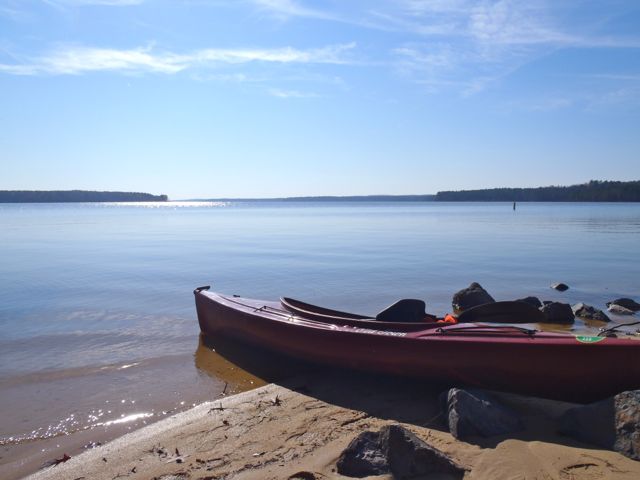
The only thing better than paddling a coastal swamp is paddling it with a knowledgeable naturalist who knows the terrain and can help make sense of what can be an overwhelming experience. Sunday morning, join said knowledgeable naturalist for a two-hour kayak trip up Goose Creek at Goose Creek State Park just east of Washington. Equipment — kayaks, paddles and pfds — provided.read more
Carnage at Rest Stop #4, on the Blue Ridge Parkway.
Before Sunday’s ORAMM mountain bike race in the Pisgah National Forest, I’d heard it said that some people who have done the race never got on a mountain bike again. I’d also heard of those who barely survived ORAMM, yet couldn’t wait to do it again.
After doing the race, I can understand both sentiments, though I will admit the latter didn’t begin to take hold until well after the race as I lay grime-coated and spent in my tent.
ORAMM stands for Off Road Assault on Mount Mitchell, a nod to its paved and better-known cousin, Assault on Mount Mitchell, a 103-mile road race that begins in Spartanburg, S.C., and ends atop Mount Mitchell. ORAMM starts in Old Fort and and takes a circuitous 63-mile route north into the Black Mountains and back. Maybe five miles is on paved road (mostly getting out of and back into Old Fort); the rest is on gravel Forest Service road and singletrack trail. There’s 11,000 total feet of climbing along the way, and the event’s Web site advises: “Do not underestimate the extreme difficulty and danger of this event. The course is extremely demanding and travels over rugged terrain with extreme elevation changes. … It is not uncommon to see wildlife such as a wild cat or a black bear. Be ready to cope with any circumstances!! Please note that firearms are not permitted in certain areas.”
Not surprisingly, the folks who attempt such a challenge look like they don’t mind a little extreme difficulty and danger, or bear wrestling, for that matter. Checking out my 500 or so competitors at the start I saw maybe 5 pounds of fat — combined. Just looking at the race field it would be easy to be intimidated. And yet spend 10 hours and change riding 63 miles through bear country with them and you come away with a broader appreciation of who would chose to spend a Sunday riding through the highest mountains on the East Coast.
At the start, I ran into Steve Rogers from Chapel Hill. Steve and I are both in our 50s and I see him at every race in the Triangle. He’s a more devoted rider than I am and better because of it. He’s competitive, sure, but when he heard a couple weeks back that I was doing ORAMM, he emailed me some valuable and helpful advice from his experience racing in the mountains. Sunday before the start he attempted to put my prerace jitters at ease.
“Ah, you’ll have a fun day.” I’m pretty sure he meant it.
Fifteen miles into the race, at the first rest stop, I ran into Andrew Katz. Andrew is a managing partner of Morrisville’s Triangle Rock Club (a sponsor of this blog) and may be the most adventure-driven person I know. His specialty is mountaineering, but he’s also an accomplished whitewater kayaker, scuba dives, runs marathons and triathlons and does adventure races. He broke his arm doing the latter last year, which has limited his time on the mountain bike: “I’ve ridden exactly twice in the last year,” he told me. Yet despite having no chance of besting his previous ORAMM record of just over 8 hours, he may have been the happiest guy on the course.
“It’s such a great day!” he said.
As I was hitting the 30-mile mark around 12:30 p.m., if occurred to me that the top riders were just now finishing. Done — and I still had more than half the race left. Then I passed a guy walking his bike up a gentle climb.
“Cramps?” I asked.
He nodded solemnly. Cramps — and he still had 33 miles and most of that 11,000 vertical feet to go.
A couple miles later I was also pushing my bike, up the endless Curtis Creek Road to the Blue Ridge Parkway. I passed a fellow pusher who complimented me on my prowess. “Practice,” I advised. A little later I passed a kid in his 20s pushing his bike but mostly using it for support. “I think I ate some bad Gu,” he said, his sweaty, helmeted head facing the ground. “Save me a drink when you get to the rest stop,” he requested.
Around 2:30 the inevitable summer afternoon thunderstorm moved in. We had just left Rest Stop #4, on the Blue Ridge Parkway, where the race route spends a mile before exiting onto the aptly named Heartbreak Ridge Trail. Drizzle at first, then, as we pushed our bikes up the quarter-mile climb up Heartbreak, the rain picked up. At the summit, several of us stopped. One guy who had done ORAMM before, began telling a story.
“My dad did a marathon when I was little,” he began. “The farthest he had run until then was 8 miles. When he finished he told my mom that if he every talked about running another marathon, she needed to tell him no. Well, a year later the same marathon rolled around and my dad said, ‘You know, I think I’ll do that marathon again.’” He paused. “I guess I’m destined to repeat my father’s mistakes.”
On the rocky, rooty drop down Heartbreak Ridge, the clouds let loose. An already technical trail was now slippery and, in spots, consisted of peanut butter mud. A half mile down I passed a couple sitting on a rock. I didn’t think much of them until a little while latter and another rider asked if I’d seen the two. “Man, she was crying. I think the descent was freaking her out. I don’t know how it wouldn’t freak you out if you weren’t an avid downhill mountain biker.”
I rolled into Rest Stop # 5, the last rest stop at 4:20 p.m..
“How much farther?” I asked.
“About 11 miles from here,” answered the aid station volunteer.
“And it’s mostly downhill?”
“It’s six and a half back up to Kitsuma, then it’s downhill.” Kitsuma is a legendary climb that greets ORAMM racers about five miles in and spanks their behinds with five miles to go. There are 13 switchbacks to the top, all 26 (13 x 2), I walked. I did the first 13 under the pretense of maybe being able to ride one. There was no pretense the second time around. After reaching the summit, I climbed back on the bike, only to discover that more sore than my legs were my arms and shoulders, which had taken a severe beating jolting down Heartbreak Ridge. It was here that I could understand why someone might entertain a Craig’s List ad after getting back to Old Fort. Instead, the first thing I did after crossing the finish was get my beer chits and cash one in on a Ranger IPA. I sprawled out on the grass, took a sip and, I believe, took a short nap.read more
“You came all the way from Cary?” the woman exclaimed. “That’s, like, an hour away.”
She and a friend were asking directions from a guy who seemed to be something of an impromptu trail ambassador when I walked up. We were standing at about the midpoint of the 4.25-mile Glencoe section of the Haw River Trail, just downstream of the NC 62 bridge. Although an hour didn’t seem like that far to drive for a hike, it did occur to me that it might seem far on a day when the temperature and the humidity were both in the low 90s.
“Have you been here before?” the trail ambassador asked?
“Oh, yes,” I said. “In more hospitable weather.”
The Haw River Trail is a 70-mile work-in-progress that will eventually link two state parks: Haw River State Park to the north with Jordan Lake State Recreation Area to the south. About half of the trail will be part of the statewide Mountains-to-Sea Trail.
At present, less than 20 miles of the Haw River Trail exists. One of the longest stretches is the Glencoe section, which runs from (and along) the Indian Valley Golf Course downstream to the Stoney Creek Marina. It’s an entertaining stretch, for several reasons:
Part of it is on a golf course. On the north end, the trail traces at least three fairways of the Indian Valley Golf Course. (Please observe golf course hiking etiquette, including: speaking in hushed tones when play is in progress and standing still when a player is putting. Also: There is icy cold water at the No. 5 tee box.)
In the gentrifying mill town of Glencoe, the trail does a horseshoe up Hodges Road and back down Glencoe Street, giving you the opportunity to check out the revived mill homes.
Also in Glencoe, the trail passes the Textile Heritage Museum, fascinating look at the local and statewide textile industry. A great diversion that’s free. Hours are limited, though: 1-4 p.m. Saturdays and Sundays.
Just over a mile downstream from Glencoe is the old and abandoned Carolina Mill.
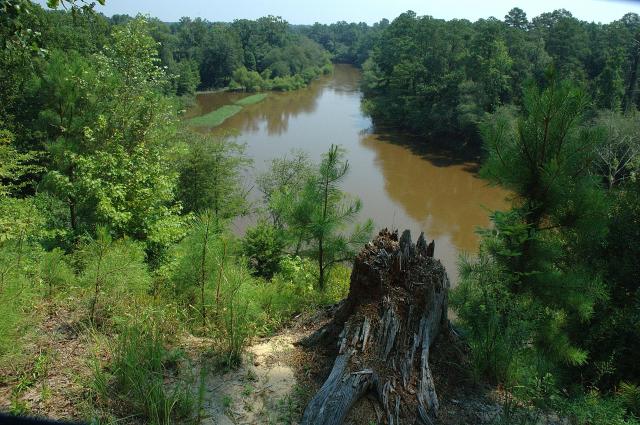
Just beyond that, the trail departs from the dense jungle along the Haw and quickly climbs into a drier oak/hickory forest typical of the Piedmont.
Stoney Creek Marina.
I would not recommend this stretch of trail in 90/90 weather. Even a stout breeze has trouble penetrating the dense foliage along the trail and the occasional stretches of open trail can be broiling.
I would, however, recommend it for more civil weather, such as the weekend ahead, when temperatures are expected to cool into the 80s. I recommend starting mid-trail in Glencoe (you can pick up a trail map at the paddle access at River Road and NC 62), doing an out-and-back (upstream to the golf course, downstream to the marina), then checking out the museum.
A good outing for kids, btw: The trail offers a jungle escape, the textile museum has toys circa grandma & grandpa.read more
Cary's Black Creek Greenway under construction at Castalia Drive.
“Hey,” I said interrupting whatever it was we were talking about. “That’s the Black Creek Greenway, isn’t it?”
Why I hadn’t noticed the bulldozer busy at work just beyond the Cycle Surgeon’s property line, I’m not sure because this was the fifth time in less than a week that I’d been at the Surgeon’s Cary garage as he patiently tried piecing together the bike I was borrowing after I’d broken the frame on mine. “I don’t want to spend a lot to get it running,” I’d say every time I brought the newly broken loaner in. Then, noting I have a race this Sunday, I’d add, “And I need it immediately.”
Matt Lodder, a k a the Cycle Surgeon, confirmed that it was indeed the vital last link in the Black Creek Greenway, a vital link between Umstead State Park and Raleigh’s 69-mile greenway network and Cary’s White Oak Creek Greenway, which is close to connecting to the American Tobacco Trail, which is close to connecting to downtown Durham.
“They sent us a letter in March saying they were going to start construction and that it would be done by the end of the year,” Matt said.
When finished, the Black Creek Greenway will run 5.6 miles, from Lake Crabtree County Park to the northeast to Cary’s Bond Park, just over a half mile to the west. Five miles of the greenway is complete; the remaining 0.6 of a mile is what is currently under construction. That stretch includes, according to the Town of Cary Web site:read more