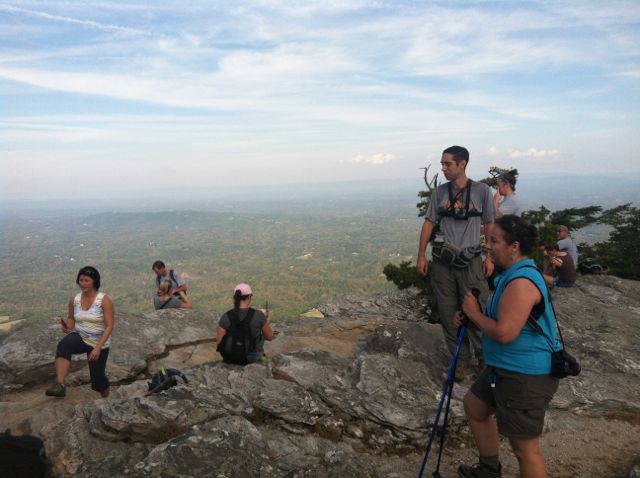
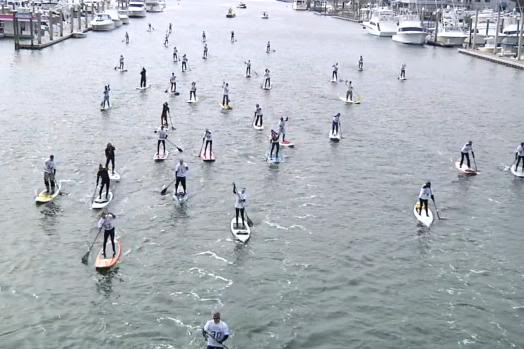
Why do I push hiking?
For one, it’s accessible. North Carolina is blessed with great hiking trails. No matter where you live, from the coast to the mountains, there are great trails a short drive away. (We even have a trail, the Mountains-to-Sea Trail, linking the coast and the mountains.)
Hiking is social. Of all the ways you can get your heart rate up, hiking is perhaps the most amenable to doing so with friends. The movement, the fresh air, the surroundings regardless of where they are, all contribute to a convivial atmosphere.
It’s soothing. For a lot of us, being in the woods is a sedative. That’s not just me talking, there’s science to back that up (see below).
It doesn’t feel like a workout. Sure, there may be times at the end of a long day where you realize your body is working, but typically that realization doesn’t occur until later on — when you try to get out of the car, for instance.
All of which is why last September GetGoingNC, with support from Great Outdoor Provision Co., launched the GetHiking! program. GetHiking! focuses on two audiences: Folks who have long been interested in hiking but, for whatever reason, have yet to take their first step into the woods. And more experienced hikers who would hike more if they knew more places to hike.
For the former, our hikes are lead from the rear, meaning you’ll never hike alone. A guide will always be at the back of the pack. For the latter, we try and hit new trails every week, ensuring that you expand your universe of hiking options.
The program launched in the Triangle in September. To date, we now have more than 500 members. Our weekly hikes can be intimate, with as few as 15 hikers, or they can be events, with upwards of 70 participants.
Based on our response in the Triangle, we are expanding GetHiking! into Winston-Salem and Charlotte, with hikes scheduled to begin in both regions later this month. You can learn more about the Triad program here, GetHiking! Charlotte here. And you can find out about our hikes and other events, and join up, by visiting the following:
This weekend: Run, hike … snowshoe?
There’s a half marathon at the coast and a thoughtful hike in the Piedmont this weekend in North Carolina. And, weather permitting, you can do the unexpected in the high country: go snowshoeing!
Coast
Saturday’s Ocean Isle Bridge Run for Food half marathon has been a recent topic of conversation in our household. Our oldest is running the race; a cross-country runner during his days at Enloe High School, this is his first 13.1-miler. We’ve discussed what for him are the unknowns: the advantages and disadvantages of a long flat course, the impact of a usually constant ocean breeze/wind/hurricane-force-blow, the weather. We’ve discussed pace and a target time. All of which has made me wish I was in condition to run a half marathon Saturday at Ocean Isle.
New trail: Dig it

Fred Dietrich, who oversees construction and maintenance of the Mountains-to-Sea Trail in Durham and Orange counties, reports: “2013 was a good year for the Eno River Section of the MST trail. Thanks to your hard work we were able to keep the trail maintained, and to build the final section and final bridge to complete the trail between Penny’s Bend and West Point on the Eno.
“Over the past five years,” he adds, “we have built three sections of trail that are now part of the completed 14.8 miles of trail from Pleasant Green Road to Penny’s Bend.”
Nearly 15 miles of uninterrupted trail from Pleasant Green Road to Penny’s Bend. And at Penny’s Bend, you hook up with another 60 miles of uninterrupted MST along the south shore of Falls Lake.
That’s 75 miles of uninterrupted hiking on natural surface trail.
How does a metro area come to have a 75-mile (and growing) hiking trail in its midst? Same way the Mountains-to-Sea Trail, stretching from Clingman’s Dome to Jockey’s Ridge, is now more than 500 miles finished: because of people such as yourself. People who don’t mind rolling up their sleeves once a month and spending a Saturday building and maintaining trail. If you haven’t yet joined the ranks of dedicated MST volunteers, now’s the time to do so. We’ve even got a list of Fred’s monthly work days that you can jot into your calendar. Pencil ready?
The cold facts
It’s cold: waking up to 9 degree temperature is cold in anyone’s book, no matter how cold-blooded you are, no matter where you live.
But how cold is it? And how does that cold affect us when we venture out?
Understanding what’s going on when your exercising body interacts with the cold is key to figuring out how to deal with frigid conditions. Proper preparation for the cold and being able to read the signs of how your body is reacting can mean the difference between a day of exploring in the winter woods or Netflix. As is the case with so many matters concerning the active outdoor life, a great source of information is Princeton University’s Outdoor Action website. And in the case of matters concerning the cold, their comprehensive “Outdoor Action Guide to Hypothermia and Cold Weather Injuries.”
“Traveling in cold weather conditions can be life threatening,” writes Rick Curtis, who heads the outdoor program at Princeton. “The information provided here is designed for educational use only and is not a substitute for specific training or experience.”
Disclaimer obediently noted, here’s a very quick primer on hypothermia:
Can initially be tipped off by signs of the “umbles — stumbles, mumbles, fumbles, and grumbles which show changes in motor coordination and levels of consciousness.”
Involuntary shivering is a sign of mild hypothermia, slurred speech a sign of moderate hypothermia, dilated pupils is a sign of severe hypothermia, erratic and very shallow breathing is a sign of, well, you don’t want to reach that point.
To deal with the onset of hypothermia you should reduce heat loss by adding clothes, switching to dry clothes if your clothes are wet, move, seek shelter; eat and drink; find heat, through a fire, for instance, or direct body contact.
Learn more about hypothermia as well as vasodilation, vasoconstriction, the pathophysiology of tissue freezing and a whole lot more by visiting the “Outdoor Action Guide to Hypothermia and Cold Weather Injuries.”
90 Second Escape: Summer in January
Monday — never an easy time for the outdoors enthusiast. After a weekend of adventure, returning to the humdrum work-a-day world can make one melancholy. To help ease the transition, every Monday we feature a 90 Second Escape — essentially, a 90-second video or slide show of a place you’d probably rather be: a trail, a park, a greenway, a lake … anywhere as long as it’s not under a fluorescent bulb.
Today’s 90-Second Escape: Summer in January