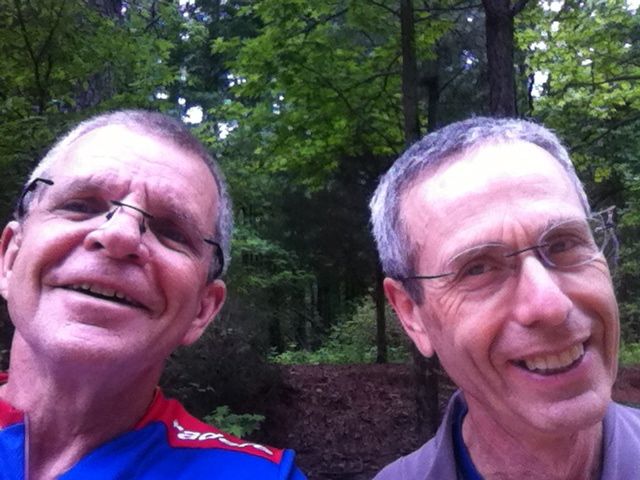
In more than two decades of writing about health, fitness and outdoor adventure, last night I did something I’ve never done before.
I covered an activity without participating in it.
The activity? Parkour.
Parkour, as one of the dads at Enso Movement in North Raleigh told me, is a “young man’s game.”
I’ll be writing about parkour in the next week or two for The News & Observer. For our purposes today, suffice it to say parkour is a way of gracefully going from Point A to Point B in a straight line, obstacles be danged. Participants gingerly vault, leap, climb and hurdle their way through an urban landscape, refusing to acquiesce to stairs and sidewalks. It sounds dangerous; it is the antithesis thereof. The class I watched — five boys and one girl ranging in age from 12 to 16 — spent the first 20 minutes warming up and getting loose. Instructor Alan Tran spent the remainder of the 75-minute session working on technique for safe launches and landings. This ain’t about Russian teens drinking a fifth of vodka, then blithely skipping from one skyscraper rooftop to the next.
It’s also not about a 58-year-old guy using one hand to hurdle a three-foot wall. And I knew it.
Usually, when I call to ask about covering an activity, I get an invitation to join in. In reporting on everything from rock climbing to parasailing to cave diving, I’ve put down pen and paper to partake. When I approached Enso Movement, there was no mention of coming prepared to join the fun. A young man’s game, it was presumed.
When I asked Tran who their oldest student was, he deferred to fellow instructor Nick Faircloth.
“Late thirties, maybe,” Faircloth said with an air of awe. “Maybe even early 40s!” (Tran noted that in Europe, where parkour has been big since the early 1990s, there are senior parkour classes, “for 65 and up.”)
After the warm-up, as the teens began navigating plywood obstacles in Enso Movement’s warehouse gym, their antics took me back to suburban Denver in the 1960s. Full of energy and flexibility, my pals and I would roam our neighborhood, hopping fences, leap-frogging ashpits, using street signs as stripper poles. I was also reminded of how incredibly incompetent I was at this type of movement. Ever beyond my grasp was how to leap a fence with only my hands touching, or how to gain sufficient liftoff to clear that three-foot brick ashpit. As Tran showed his aspiring “traceurs,” it was as much about technique as strength. Maybe if he’d been my neighbor back on South Boston Court, I would have been a more effective — and less bruised — navigator of the night. Alas, I realized, my time had passed.
Sidelined for the first time in my participatory reporting career wasn’t a milestone to relish. It wasn’t one to despair over, either. Maybe I can’t hurdle a fence.,
But I can still ride a skateboard.read more
My buddy Alan and I celebrate our birthdays (they're a day apart) by doing a mountain bike ride that's the average of our combined ages. This year, we rode 58 miles.
As I was poring over the results of Sunday’s Off Road Assault on Mount Mitchell, I was surprised to see that of the nearly 400 riders who finished the 63-mile race, only five were older than me. (I was less surprised that all five finished ahead of me.)
Perhaps I shouldn’t have been; at 56 years of age, you might think that wisdom would finally overpower the need to punish one’s self, thus keeping contemporaries away.
Apparently not.
I became curious about my fellow silver cyclists and discovered that, indeed, we are not becoming sedate and reflective in our golden years. According to the National Sporting Goods Association, the number of mountain bikers age 55 or older grew by more than 41 percent in the past decade. In 2011, there were 383,000 mountain bikers who were eligible for 10 percent off their curly fries at Arby’s, up from 271,000 10 years earlier. (Curiously, the overall number of mountain bikers dropped 5.5 percent during the same 10-year span.)
Mountain biking was no anomaly. The number of 55ers working out at gyms climbed 614 percent during the period, the number of 55+ kayakers rose by 350 percent, the number who did aerobic exercise increased by 226 percent. Growing interest in these more active pursuits outpaced growth in activities typically associated with a graying population: golf, darts, fishing and bowling, to name a few.
This week, Ultimate Hike Raleigh began its recruiting sessions in the Triangle and, again, I shouldn’t have been surprised by the number of people in the audience who also looked like they remembered “Fernwood Tonight.” At the end of Tuesday evening’s info session Tuesday at the North Hills REI I struck up a conversation with a 50-year-old woman who had signed on for the 28.5-mile hike to benefit pediatric cancer. She spoke about taking challenging hikes in the Smokies with her 20something daughters — and about how both loathed the experience. Neither were out of shape, she said. They just didn’t like hiking for that long.
We speculated as to why mom enjoyed the hike, her young, fit daughters not so much. Are you more accustomed to suffering the older you get? Do your performance expectations diminish to the point where you don’t care if it takes all day to do something? Or does it take so long for your body to get warmed up that when you finally get there you simply don’t want to stop? Does it really matter, since we’re the ones happiest with epic adventures?
Again, apparently not. Perhaps reflective of another benefit of aging we concluded that time was short and dropped the topic in favor of one more appealing.
Our one day, 28.3-mile Ultimate Hike.read more
A year ago today, I wrote about all the things I planned to do in my 55th year. 55 things, in fact, all tied to the number 55. My inspiration came in large part from a National Institutes of Health report noting that men generally start dropping weight and, the report added, start falling apart at 55. If that’s the case, I thought, then I need to start working extra hard.read more
I turned 55 today and celebrated with a 30-minute ab workout.
I had to: According to the National Institutes of Health, while 55 is when males generally start dropping weight (sorry gals, it doesn’t happen for you until around 65), I’m now more inclined to hang on to the weight I’m keeping — in the form of fat — around my midsection.read more
From the research world comes more incentive to stay active — or become so — as you age.
From the Albert Einstein College of Medicine at Yeshiva University comes “preliminary evidence” that keeping your brain sharp can help you physically. Einstein researchers took a group of 20 “frail” seniors (age 70 or older who walk less than a meter per second) and divided them into two groups. Ten went about their normal routines, 10 participated in the MindFit brain fitness program: For 45 to 60 minutes a day, three days a week for eight weeks, they carried out tasks that honed their cognitive abilities: focusing, planning, organizing, problem solving. After eight weeks, the MindFit folks walked slightly faster, but their ability to walk and talk at the same time improved significantly.read more