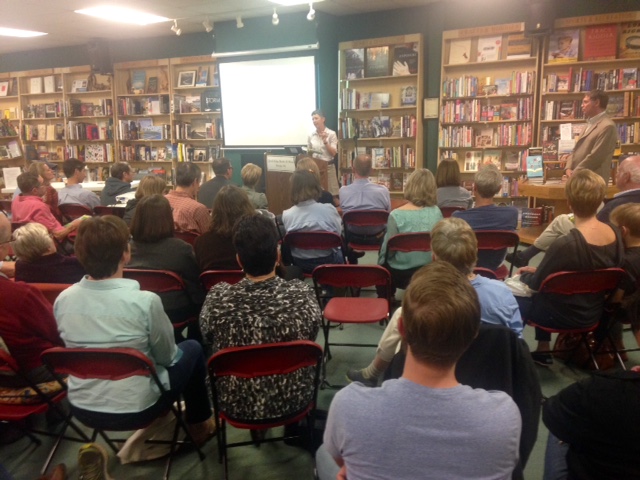
Steph Jeffries, standing center, and Tom Wentworth, standing right, tag-team the launch of their new "Exploring Southern Appalachian Forests."
A few years back I was nearing the top of the Mount Mitchell Trail when I came across a group of youngsters intently examining the balsam firs that begin appearing above 5,500 feet. As they probed about, an older fellow explained what they were seeing. The gentleman had a professorial look; not surprising, I soon discovered, considering these were forestry students from N.C. State. I lurked in the shadows and got a free education on the challenges of life above 6,000 feet in a Southern Appalachian forest. Sure be great if you didn’t have to go to school to get this kind of education, I thought.
Last night, I discovered, you don’t.
Before a packed house Tuesday evening at Quail Ridge Books & Music in Raleigh, Steph Jeffries and Thomas Wentworth discussed their just-released guide, “Exploring Southern Appalachian Forests: An Ecological Guide to 30 Great Hikes in the Carolinas, Georgia, Tennessee, and Virginia” (UNC Press). It’s a scientific look at the forest written for a lay audience.
Jeffries and Wentworth are uniquely qualified to write “Exploring Southern Appalachian Forests.” As N.C. State professors — she in the Department of Forestry, he in Plant and Microbial Biology — they’ve been exploring these woods for years. On one outing with students several years ago, Jeffries yelled to Wentworth: “We need to write a book about this.”
“Exploring Southern Appalachian Forests” is peppered with insights that can’t help but make a hike all the more enjoyable. A sampling:read more
In more than two decades of writing about health, fitness and outdoor adventure, last night I did something I’ve never done before.
I covered an activity without participating in it.
The activity? Parkour.
Parkour, as one of the dads at Enso Movement in North Raleigh told me, is a “young man’s game.”
I’ll be writing about parkour in the next week or two for The News & Observer. For our purposes today, suffice it to say parkour is a way of gracefully going from Point A to Point B in a straight line, obstacles be danged. Participants gingerly vault, leap, climb and hurdle their way through an urban landscape, refusing to acquiesce to stairs and sidewalks. It sounds dangerous; it is the antithesis thereof. The class I watched — five boys and one girl ranging in age from 12 to 16 — spent the first 20 minutes warming up and getting loose. Instructor Alan Tran spent the remainder of the 75-minute session working on technique for safe launches and landings. This ain’t about Russian teens drinking a fifth of vodka, then blithely skipping from one skyscraper rooftop to the next.
It’s also not about a 58-year-old guy using one hand to hurdle a three-foot wall. And I knew it.
Usually, when I call to ask about covering an activity, I get an invitation to join in. In reporting on everything from rock climbing to parasailing to cave diving, I’ve put down pen and paper to partake. When I approached Enso Movement, there was no mention of coming prepared to join the fun. A young man’s game, it was presumed.
When I asked Tran who their oldest student was, he deferred to fellow instructor Nick Faircloth.
“Late thirties, maybe,” Faircloth said with an air of awe. “Maybe even early 40s!” (Tran noted that in Europe, where parkour has been big since the early 1990s, there are senior parkour classes, “for 65 and up.”)
After the warm-up, as the teens began navigating plywood obstacles in Enso Movement’s warehouse gym, their antics took me back to suburban Denver in the 1960s. Full of energy and flexibility, my pals and I would roam our neighborhood, hopping fences, leap-frogging ashpits, using street signs as stripper poles. I was also reminded of how incredibly incompetent I was at this type of movement. Ever beyond my grasp was how to leap a fence with only my hands touching, or how to gain sufficient liftoff to clear that three-foot brick ashpit. As Tran showed his aspiring “traceurs,” it was as much about technique as strength. Maybe if he’d been my neighbor back on South Boston Court, I would have been a more effective — and less bruised — navigator of the night. Alas, I realized, my time had passed.
Sidelined for the first time in my participatory reporting career wasn’t a milestone to relish. It wasn’t one to despair over, either. Maybe I can’t hurdle a fence.,
But I can still ride a skateboard.read more
Monday — never an easy time for the outdoors enthusiast. After a weekend of adventure, returning to the humdrum work-a-day world can make one melancholy. To help ease the transition, every Monday we feature a 90 Second Escape — essentially, a 90-second video or slide show of a place you’d probably rather be: a trail, a park, a greenway, a lake … anywhere as long as it’s not under a fluorescent bulb.read more
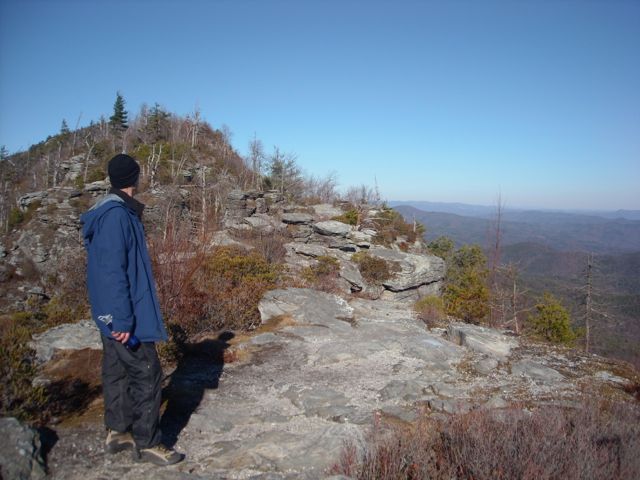
Hiking: Looking into Linville Gorge from atop Shortoff Mountain.
Scott Carpenter has a vision that may seem myopic at first. Hear him out, though, and your adventurous self can easily see what he’s talking about.
Carpenter’s vision is this: Lake James, the 6,800-acre lake currently best known as the gateway to other adventurous places (Linville Gorge, Wilson Creek, the Pisgah National Forest) is the next Nantahala Outdoor Center, an all-encompassing outdoor playground that’s day-tripable from North Carolina’s major population centers: Charlotte, the Triad, the Triangle.
Carpenter is Deputy County Manager and Planning Director for Burke County, in which Lake James and its associated state park reside. Burke County, like many mountain counties, is dealing with a changing economy that must figure out how to rely less on manufacturing and more on … .
“Tourism,” answers Carpenter.
The ultimate goal, says Carpenter, is to lure an NOC-type outfitter to the region to help exploit the local recreational resources. Chances are, if you see the Lake James exit on I-40 as little more than a sign that you’re almost to where the fun starts, you’re scratching your head: What can I do at Lake James that doesn’tread more
A good time for adventure planning at the coast, a great time to get to know a creek in the Piedmont, and a hike that proves you don’t have to go that extra mile for great scenery in the mountains.
Coast
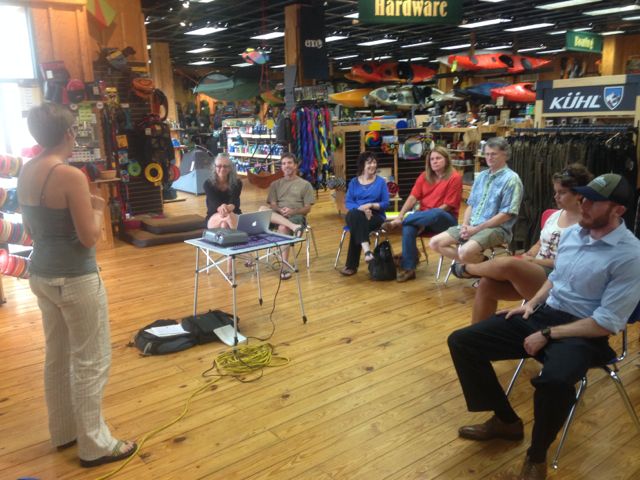
If you live in the Greenville area and bemoan the lack of organized outings in the region, take note of a new Meetup in the region: GetExploring! Greenville. Just so we’re square here, GetExploring! Greenville is sponsored by Great Outdoor Provision Co. and was created as part of GetGoingNC’s Get! division, our effort to become more actively involved in getting you involved.read more